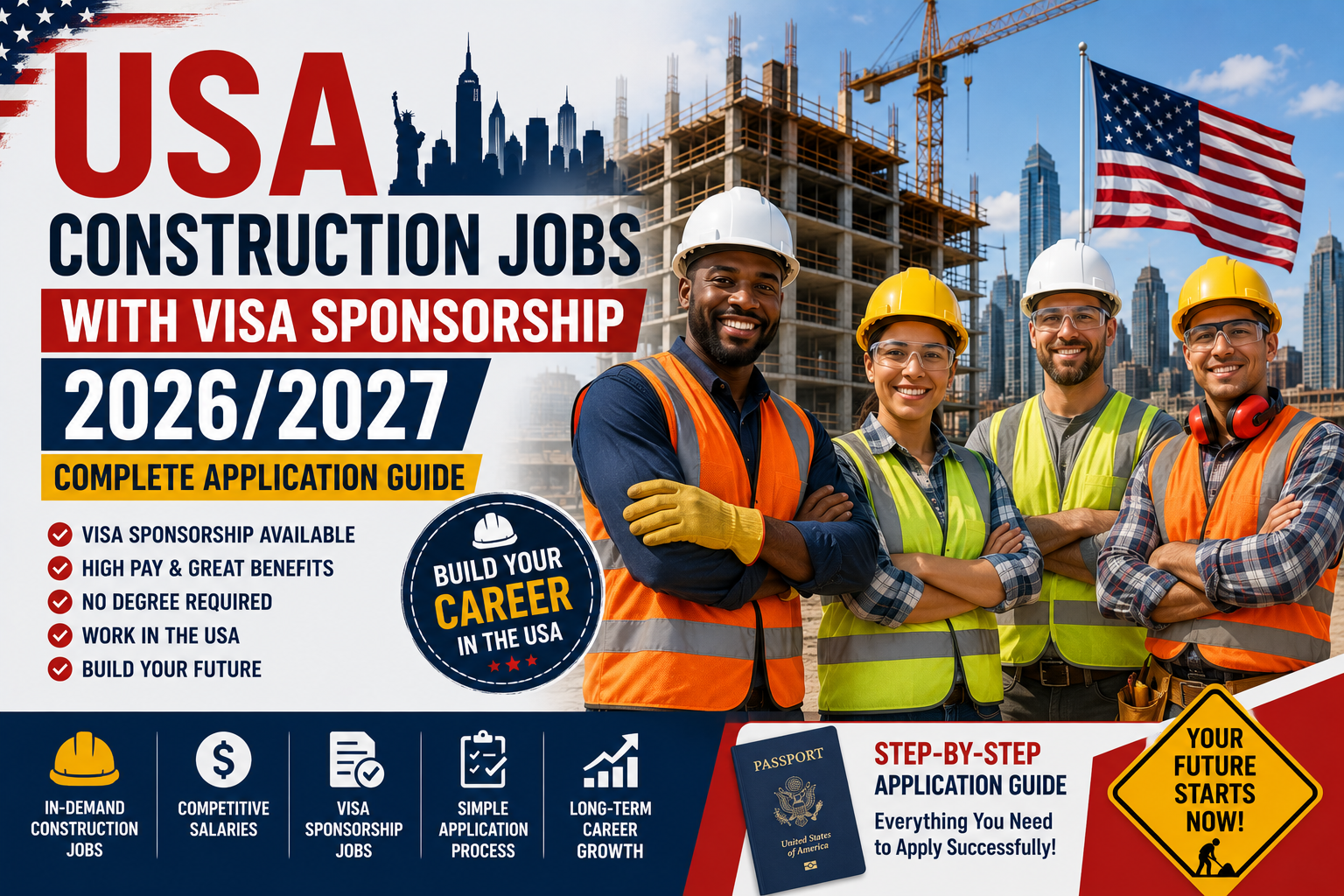
USA Construction Jobs with Visa Sponsorship 2026/2027: eligibility, H-2B and H-1B pathways, real wages, and a complete step-by-step application guide.
Introduction
Could a hammer and a work boot get you further in the US immigration system than a diploma? For thousands of foreign tradespeople, the answer is yes — USA Construction Jobs with Visa Sponsorship remain one of the more accessible legal pathways into the American workforce, degree or no degree.
Construction is one of the largest H-2B visa user industries in the country, covering everything from general laborers and carpenters to equipment operators and skilled welders. With housing developments, infrastructure projects, and data center construction booming across multiple states, US employers are actively filing labor certifications to bring in foreign workers when local hiring pools fall short.
Unlike white-collar sponsorship routes that hinge on a bachelor’s degree, most construction sponsorship flows through the H-2B visa, a temporary work category built specifically for seasonal and peak-load labor needs. That doesn’t mean it’s simple — annual visa caps, strict application windows, and Department of Labor certification requirements all shape how competitive this process really is.
This guide breaks down exactly how construction visa sponsorship works, which trades are hiring, what you can expect to earn, and how to apply the right way. If you’re researching entry-level construction jobs in USA, welding jobs in USA with visa sponsorship, or simply wondering how to get a construction job in USA from abroad, you’re in the right place.
Why US Construction Is Actively Hiring Internationally
The construction labor gap in the United States isn’t a fringe issue — it’s a well-documented industry-wide challenge.
- Booming project pipelines. Housing developments, commercial builds, and a surge in data center and renewable-energy infrastructure construction have all increased demand for labor simultaneously.
- Aging domestic workforce. Many skilled tradespeople are approaching retirement, and fewer young American workers are entering trades at the same rate.
- Seasonal peak demand. Construction activity spikes heavily in warmer months, creating short-term labor gaps that are difficult to fill with local hiring alone.
- Federal recognition of the shortage. The Department of Homeland Security has periodically authorized supplemental H-2B visas specifically to address labor shortages in construction and hospitality, on top of the standard annual allocation.
That federal support matters, because it directly shapes how many visa slots are actually available each year — and that number is limited.
Understanding Your Visa Options
1. H-2B Visa: The Primary Pathway for Most Construction Roles
The H-2B visa is designed for temporary, non-agricultural work and is by far the most common route into US construction jobs for workers without a degree.
- Annual cap: USCIS limits H-2B visas to 66,000 per fiscal year, split into two allocations of 33,000 — one for the winter half of the year and one for the summer half
- Seasonal concentration: Construction projects are heavily concentrated in the summer allocation, which tends to fill quickly
- Duration: Labor certification can run up to 1 year for one-time need positions, or up to 10 months for seasonal, peak-load, or intermittent need
- Maximum stay: Workers can remain on H-2B status for up to 3 years total before needing to leave the US for at least two months before reapplying
- Supplemental visas: DHS has, in past cycles, authorized additional H-2B visas beyond the standard cap specifically to address construction and hospitality shortages — always check current-year allocations, since these supplemental numbers vary annually and aren’t guaranteed
2. H-1B Visa: For Specialized, Degree-Requiring Roles
If your background includes formal education, the H-1B pathway applies to specialized occupations like construction management, civil engineering, or project management roles requiring a PMP certification alongside a relevant degree.
- Annual cap: 85,000 visas nationally, allocated through a lottery system
- Who it fits: Construction professionals with a bachelor’s degree in construction management, civil engineering, or a closely related field — general contracting experience alone won’t meet the “specialty occupation” standard required
3. TN Visa: A Fast Track for Canadian and Mexican Citizens
Under the USMCA agreement, Canadian and Mexican citizens working in civil engineering, architecture, or related qualifying occupations can use TN status.
- No annual cap, and it can be renewed indefinitely
- No employer petition required — just a qualifying job offer and the right credentials
4. EB-3 Visa: The Permanent Route
For workers seeking long-term settlement rather than temporary seasonal work, the EB-3 category covers both skilled and unskilled permanent construction roles, offering a path to a green card rather than a temporary work permit.
In-Demand Construction Roles and What They Pay
1. General Laborers
Entry-level laborer roles remain the most accessible starting point for workers without formal trade certification, often serving as an entry route into more specialized positions over time.
2. Carpenters, Framers, and Equipment Operators
These roles form the backbone of most H-2B construction petitions, covering everything from residential framing to heavy equipment operation on commercial sites.
3. Welding Jobs in USA with Visa Sponsorship
Welding remains one of the more specialized trades within H-2B sponsorship, often commanding stronger pay than general labor roles due to the certification and skill involved. Employers frequently provide additional training or certification support as part of the sponsorship arrangement.
4. Skilled Trades: Electricians and Plumbers
Electrician and plumber positions typically move through the H-2B pathway as well, though some advanced or supervisory roles within these trades may require additional state licensing after arrival.
5. Construction Management and Engineering (H-1B Track)
For degree-holding applicants, project management and civil engineering roles offer a different, more specialized sponsorship route, often paying significantly more than trade-level positions but requiring formal credentials and facing lottery-based cap limits.
Construction Sponsorship Comparison
| Visa Type | Best For | Annual Cap | Degree Required |
|---|---|---|---|
| H-2B | General labor, carpentry, welding, equipment operation | 66,000 (split winter/summer) | No |
| H-1B | Construction management, civil engineering | 85,000 (lottery) | Yes |
| TN | Canadian/Mexican civil engineers, architects | None | Yes (qualifying credential) |
| EB-3 | Permanent skilled and unskilled roles | Subject to annual country limits | Varies by category |
Eligibility Requirements for H-2B Construction Roles
Most H-2B construction sponsorship follows a fairly consistent set of baseline requirements:
- Age 18 or older at the time of application
- Basic spoken English skills, sufficient for safety communication on-site
- Physical fitness, since most roles involve manual labor and lifting
- Relevant work experience, though many employers provide on-the-job training for general labor positions
- A confirmed job offer from a US employer willing to file the labor certification on your behalf
Some countries have specific eligibility considerations tied to the H-2B program’s list of designated participating countries, so confirm your home country’s current status before investing time in the application process.
How to Get a Construction Job in USA From Abroad: Step-by-Step
- Identify your target trade. General labor, carpentry, welding, and equipment operation each have slightly different demand levels and pay scales — decide where your experience fits best.
- Search for employers with verified H-2B filing history. Platforms that filter specifically for confirmed visa sponsorship save significant time compared to general job boards, which rarely indicate genuine sponsorship capability.
- Secure a job offer. This is the essential first step — US employers, not workers, initiate the H-2B sponsorship process.
- Employer files a temporary labor certification with the Department of Labor. This step proves that hiring you won’t adversely affect wages or working conditions for US workers, and it must be completed before petitioning USCIS.
- Employer petitions USCIS for H-2B approval, timed carefully around the twice-yearly cap windows — missing the filing window can mean waiting for the next allocation cycle entirely.
- Apply for your visa at a US consulate in your home country once USCIS approves the petition.
- Prepare for arrival, including any additional safety training or certification your employer requires before you begin on-site work.
Timing matters enormously here. Because the summer allocation for H-2B visas fills quickly due to heavy construction demand, employers often need to file well before the cap window opens — start this process as early as possible if you’re targeting summer construction work.
Construction Companies Sponsoring Foreign Workers in USA: How to Find Them
Rather than relying on generic “top companies” lists that often go stale, focus on these verification strategies:
- Look for confirmed H-2B filing history. Some job platforms specifically surface employers who have already navigated the DOL temporary labor certification process, which is a stronger signal than a generic sponsorship claim.
- Check occupation-specific listings. Trade-specific platforms often filter by visa type, letting you focus only on genuinely sponsored roles rather than sorting through unrelated postings.
- Confirm certification support. Employers who explicitly mention training or certification assistance (particularly for welding and other skilled trades) tend to have more established international hiring processes.
- Avoid unsolicited offers requesting payment. Legitimate H-2B sponsorship costs are borne by the employer, not the worker — any request for upfront fees is a serious red flag.
Common Mistakes to Avoid
- Applying too late in the cycle. The summer H-2B allocation, which covers most construction season demand, fills quickly — early applications matter significantly.
- Assuming general job boards indicate real sponsorship. Many listings don’t lead to a valid H-2B petition at all, since standard job boards rarely filter for genuine visa-sponsoring employers.
- Overlooking the H-1B degree requirement. General contracting experience alone doesn’t meet the “specialty occupation” standard for H-1B — you’ll need a relevant degree and often a PMP certification for management-track roles.
- Ignoring the 3-year maximum stay rule. H-2B status caps out at 3 years total, after which you must leave the US for at least two months before reapplying — plan your long-term goals accordingly.
Conclusion
USA Construction Jobs with Visa Sponsorship offer a genuinely practical pathway for workers without a college degree, primarily through the H-2B visa program, alongside H-1B, TN, and EB-3 routes for more specialized or permanent situations. With construction ranking among the largest H-2B user industries and federal supplemental allocations periodically expanding available visas, the opportunity is real for applicants who understand the timing and process.
Start today: pick your target trade, search for employers with verified sponsorship history, and get your application moving well before the next cap window opens. The construction industry needs skilled and reliable workers — position yourself to be one of them.
Frequently Asked Questions
Q1. Do I need a college degree to get a construction job in the USA with visa sponsorship?
No, not for most roles. The H-2B visa, which covers general labor, carpentry, welding, and equipment operation, doesn’t require a degree. Only specialized roles like construction management or civil engineering under the H-1B pathway require formal education.
Q2. How long can I stay in the US on an H-2B construction visa?
Individual certifications run up to 1 year for one-time need positions or up to 10 months for seasonal work, and workers can remain on H-2B status for a maximum of 3 years total before needing to leave the US for at least two months.
Q3. What’s the difference between H-2B and H-1B for construction jobs?
H-2B covers temporary, non-degree trade and labor roles with an annual cap of 66,000 visas. H-1B covers specialized, degree-requiring positions like project management or civil engineering, with an 85,000-visa lottery cap.
Q4. Can Canadian or Mexican construction professionals use a different visa pathway?
Yes. Under USMCA, Canadian and Mexican citizens working in qualifying occupations like civil engineering or architecture can use TN status, which has no annual cap and doesn’t require a formal employer petition — just a qualifying job offer and credentials.